It’s August, for teachers a few more weeks of leisure or a summer job, or creeping anxiety, For the chancellor and his team planning for his first school opening in an environment where education is way down the mayor’s list.
Running for office is exciting, cheering crowds of supporters, endless “high five-ing,” and the exaltation of victory. Governing is another story, the losers don’t disappear, they throw bricks, living up to campaign promises, challenging, and internal pressures from your own team. Dean Fulihan, the deputy mayor, was de Blasio’s deputy mayor, keeps the wheels greased, and knows where the bodies are buried. Mamdani’s inner circle, led by his chief of staff, Elle Bisgaard- Church carries the Democratic Socialist (DSA) flag and the mayor walks a tightrope, from waving the DSA banner to the mundane realities, namely collecting garbage.
Education is far down the mayor’s to-do list. Elle, the chief of staff, is the gatekeeper, and I suspect the chancellor has trouble getting on the face time list with the Mayor.
For the mayor educational issues are unresolveable, his educational philosophy, keep the wheels oiled, let’s solve affordability first.
Top down education “reforms,” the Science of Reading” (phonics) and other utterances from the eyries of Tweed drift away. There are no magic bullets.
The twenty-five member Panel for Educational Priorities (PEP), the school board, meets monthly, approves contracts, ignores speakers, and the just appointed thirteen new members will continue to rubber stamp what is pushed before them, the local school boards, the Community Education Councils (CEC) have no statutory role, except zoning, and even that role is questionable.
The chancellor is faced with a few difficult issues:
* school closures and/or mergers.
The school population has declined since the pandemic, part demographics, part no immigration, reverse immigration, fear of ICE, there are 250 or more schools with 200 or fewer students. School closures require CEC involvement and usually pushback; the decisions on the chancellor’s back burner. School closures can lead to demonstrations, aggressively opposed by electeds, and the city can absorb the costs, at least for now. Comptroller Brad Lander, in a detailed report suggested school mergers,
This report showcases an evidence‐based approach for one viable, potentially cost‐effective solution for compliance with the class size mandates that centers diversity, equity, and excellence for all students: intentional and inclusive school mergers. Given the high cost of new school construction, consolidation of schools to better utilize existing school buildings is likely to be among the proposals to reduce class sizes — but it must be rooted in equity and prioritize “Real Integration” rather than inequity and gentrification.
* School Integration
For years reports have called the NYC system the most segregated in the nation, from the 60s till now, with rare exceptions community or political opposition has discouraged integration plans. The chancellor has selected five districts and will assist the district in integration planning with no timetable. The UCLA Civil Rights Project finds,
Essentially all students of color attend predominantly nonwhite schools, whereas two-thirds of white students do the same. Roughly 85% of black students, and three-fourths of Latino students attend intensely segregated schools while only 11% of white and 43% of Asian students do.
There are no secrets, raising outcomes begins in the classroom, begins across a school. School leaders and classroom teachers with proper guidance and support make the difference. Actually we know what works, David Didau collects the research, unfortunately the article is pay walled, you can read most of it here.
For the past fifteen years or so, the dominant educational narrative has revolved around discovering ‘what works’. In many ways, the turn towards the science of learning has served us well, displacing a good deal of wishful thinking and making the profession more sceptical of confident assertions unsupported by robust research..
However, this has also been a period in which many schools have struggled to improve despite becoming increasingly evidence-informed. Leaders pore over dashboards in an effort to maximise outcomes. Underperformance is identified earlier, interventions become more tightly targeted and progress is measured with ever greater precision. Students are tracked to within an inch of their lives in the belief that improvement should always be measurable and continuous. Any slack, any inconsistency or plateau becomes evidence that someone isn’t working hard enough.
The result is that many schools have come to resemble finely tuned machines whose purpose is to convert effort into outcomes as efficiently as possible. Teachers and students become components to optimise, bottlenecks to remove or sources of variation to eliminate. Yet despite all this tightening, improvement often proves stubbornly elusive, while exhaustion and burnout become increasingly common.
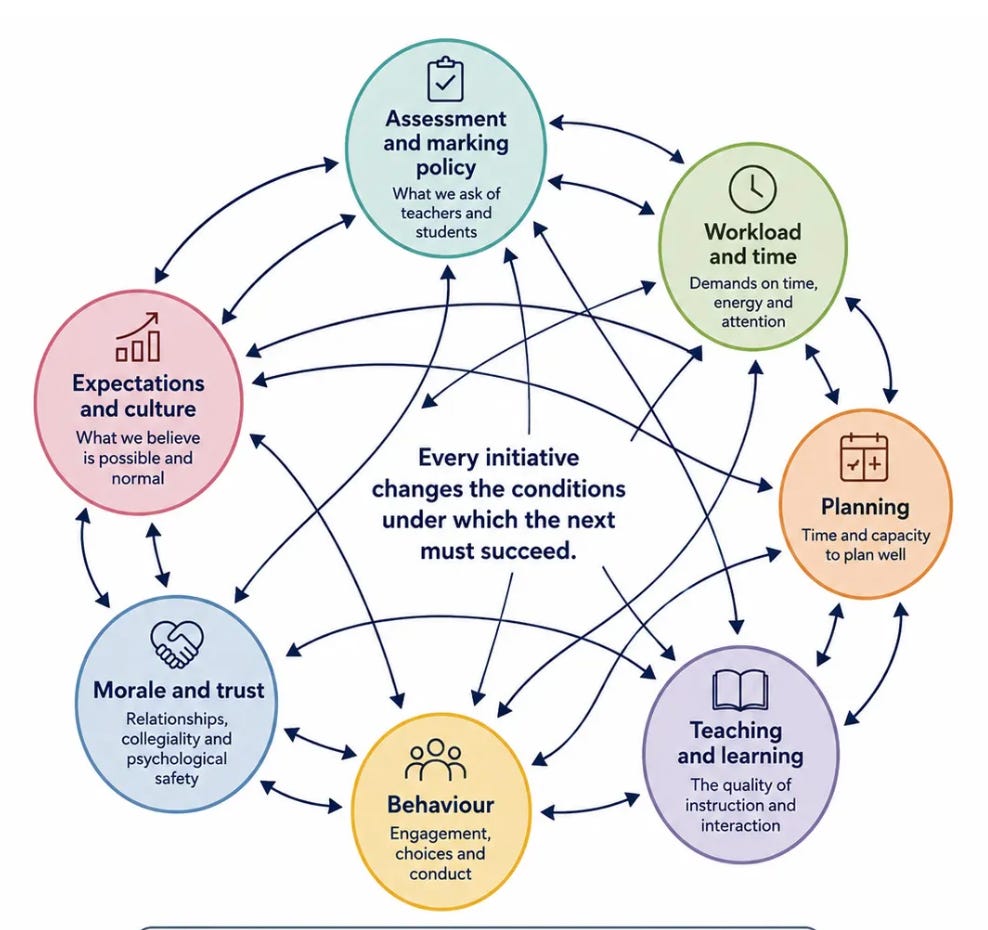
What might change if we began to see schools as ecosystems instead of machines? Instead of viewing schools as collections of discrete parts assembled into a functioning whole, we might understand them as living systems: dynamic networks of relationships, feedback loops, dependencies and adaptation. Improvement could become less about pulling the right levers and more about cultivating the conditions in which healthy systems can grow and the individual within them can flourish.
Rather than our current obsession with finding and fixing individual components, the language of ecosystems encourage us to look for patterns of interaction, feedback, adaptation and emergence. In choosing a different metaphor, alternative approaches to school improvement can be imagined.
What follows explores some of ecology’s most illuminating ideas and offers suggestions on how they could be applied to school improvement.
- Hidden networks: The unseen relationships that hold organisations together.
- Carrying capacity: Why attention is the school’s limiting resource.
- Keystone and invasive species How fashionable ideas colonise schools and crowd out better ones and developing the people, practices and relationships on which school improvement depends.
- Islands: The benefits and dangers of organisational isolation.
- Fragmentation and extinction debt: Why decline occurs before its symptoms are visible.
- Monoculture and requisite variety: The tension between consistency and adaptability.
- Reciprocity: How sustainable school improvement replenishes what it draws upon.
- Rewilding: How leadership can be conceived as the cultivation of conditions rather than the exercise of control.
The Department of Education under Bloomberg, after a number of chaotic reorganizations, turned the system over to “the best and the brightest,” Norm Fruchter chronicles the changes here A must read!
Tragically Mayor de Blasio selected a friend as the new chancellor, a retired superintendent, who turned back the clock. We’ve had six chancellors over the last twelve years (sigh). A just released report from the Center for NYC Affairs at the new School finds the free childcare will cost far, far more than the Mamdani estimates and his staff member heading the project is leaving
Sadly I believe K-12 education is far down the mayor’s list, how long can they keep treading water?
Perhaps we can begin a transition ourselves- are you on the School Leadership Team?
Explore the concepts that David Dadau lists above, can you move your school from the traditional top down management model to a collaborative culture in which ideas percolate from the bottom up? Join the UFT’s PROSE initiative, adopt an “ownership of practice” culture. If the mayor is struggling to survive, to implement his campaign promises, to a chancellor in a rut, out of the mayor’s policy loop, let’s take the reins..
 Ed in the Apple: Blogging on the Intersection of Education and Politics Title